
ID Holder: The Complete Duty-Ready Field Manual (2026)

A snapped plastic clip at the wrong moment is more than a nuisance. It is a gear failure. In high-movement environments, your id holder is a critical component of your daily loadout. Most standard office supplies fail under the stress of active duty. They crack. They snag. They drop credentials when you are moving at full speed. Industry data confirms that 85 percent of professional exchanges still rely on physical cards. This makes your retention system a primary security layer. You need hardware that stays put. No excuses.
We know the frustration of flimsy clips damaging a uniform or losing a badge during tactical movement. This field manual delivers the definitive standards for professional-grade credential retention. You will master the selection of rigid polycarbonate cases, high-density fiber reels, and secure mounting options built for operational efficiency. We examine the shift toward biometric integration and the latest 2026 compliance requirements for federal and state personnel. Expect zero-fail durability. Demand a clean, professional appearance. Substance over spectacle.
Table of Contents
Beyond the Office: Why Duty-Grade ID Holders Matter
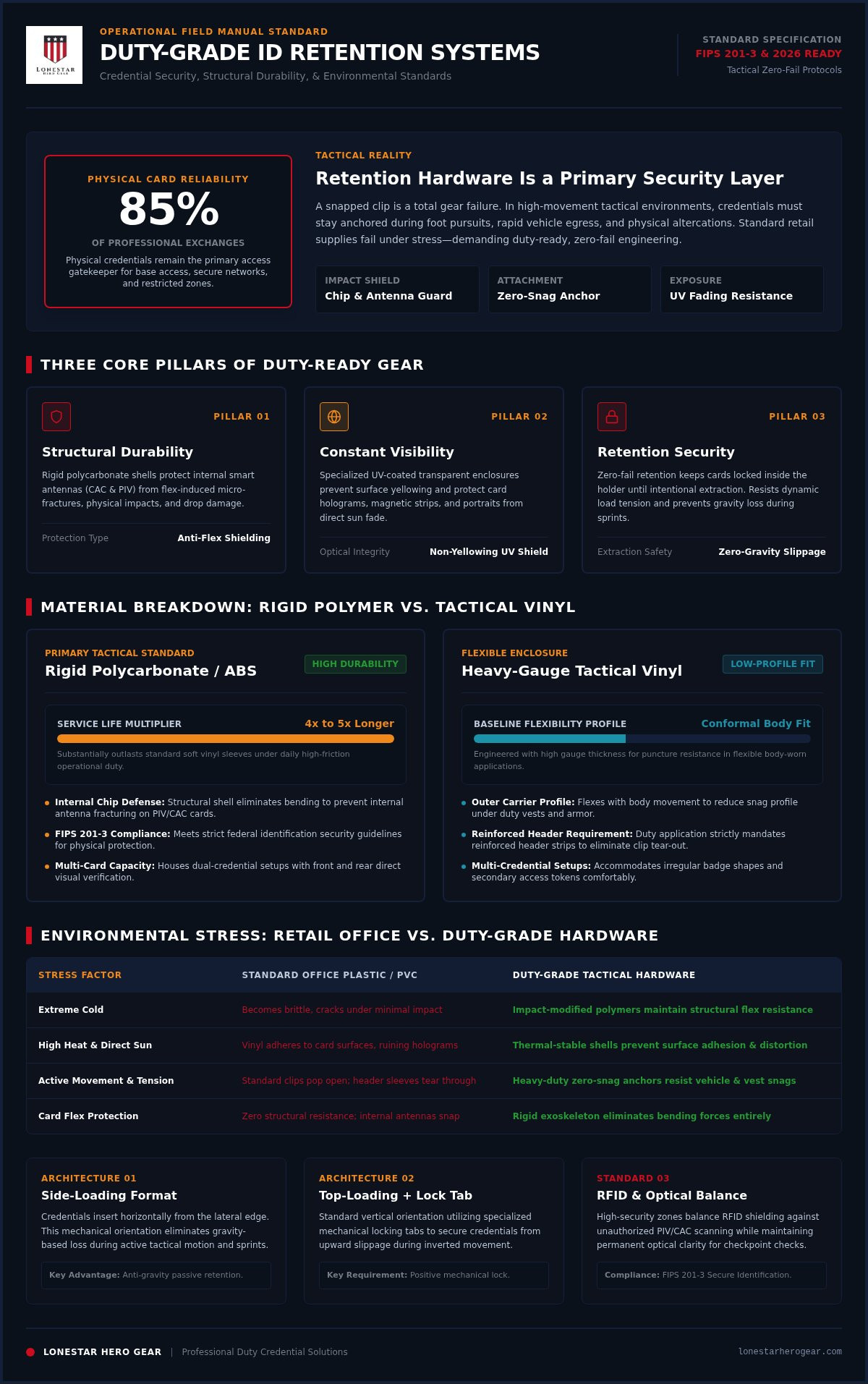
A duty-grade id holder is a specialized enclosure designed for high-stress environments. It is not an office accessory. It is a tactical necessity. For frontline personnel, an identity document serves as the primary gatekeeper for base access, secure networks, and restricted zones. Standard office supplies lack the structural integrity required for field operations. They fail during active movement. They snap under tension. Professional standards for military and first responder personnel demand hardware that survives the mission.
Generic vinyl sleeves are disposable. They crack in low temperatures. The heat causes them to stick to credentials, ruining holograms and magnetic strips. Duty-ready gear prioritizes three pillars: durability, visibility, and retention security. If your badge falls off during a foot pursuit, your gear has failed. You need equipment that withstands daily friction, environmental exposure, and physical impact.
The Duty Gear Difference
Field-ready equipment offers distinct advantages over retail-grade alternatives. The focus remains on physical survival of the gear.
Impact resistance: Rigid polycarbonate shells protect internal chips from flex damage during physical activity.
UV protection: Specialized coatings prevent credential fading caused by prolonged sun exposure.
Secure attachment: Heavy-duty mounting points resist snagging on vests, packs, or vehicle seats.
Active movement requires gear that moves with you. Standard clips are prone to opening under load. Tactical-grade attachment points ensure the
id holder
stays anchored to the uniform or lanyard regardless of the environment.
Credential Security vs. Accessibility
Operational efficiency requires a balance between rapid access and secure retention. You shouldn't fumble with your badge at a checkpoint. High-security areas often require RFID blocking to prevent unauthorized scanning of CAC or PIV cards. However, the holder must still allow for clear visual identification.
Professional settings mandate that credentials remain visible at all times. This creates a challenge. You need a transparent window that doesn't yellow over time. You also need a retention system that prevents the card from sliding out. Zero-fail retention means the card stays in the holder until you intentionally remove it. This isn't about style. It's about maintaining operational security in the field. Substance over spectacle.
Material Breakdown: Rigid Polymer vs. Tactical Vinyl
Material selection dictates gear longevity. A standard id holder relies on basic plastics. Tactical variants utilize advanced polymers or heavy-gauge vinyl. Performance varies by environment. Extreme cold turns standard PVC brittle. High heat causes low-grade vinyl to adhere to card surfaces. Professional gear must resist these failures. Your mission environment determines the build. Choose the wrong material and you risk credential loss.
Rigid polycarbonate or ABS plastic badge holders offer significant longevity. They have a service life four to five times longer than soft vinyl sleeves under daily use. This makes them the primary choice for long-term gear durability. They protect expensive electronic cards from flex damage in high-use environments. These units provide a structural shell that prevents bending. Electronic credentials like PIV and CAC cards contain internal antennas. Flexing these cards leads to hardware failure. Rigid holders ensure compliance with the FIPS 201-3 standard for secure identification.
Rigid Plastic Performance
Polycarbonate is the industry standard for high-impact environments. It maintains card integrity during physical altercations or vehicle operations. These holders often feature specific loading mechanisms to enhance security.
Side-loading: Cards slide in from the edge. This design prevents gravity-based loss during movement.
Top-loading: Standard orientation. Requires a secure locking tab to prevent upward slippage.
Multi-card capacity: Rigid cases often accommodate two cards. Front and back visibility is maintained without removal.
Flexible Vinyl and Soft Enclosures
Tactical vinyl offers versatility. It isn't the flimsy sleeve found at conferences. Duty-grade vinyl uses a higher gauge thickness for puncture resistance. Soft enclosures work best for multi-credential setups where flexibility is required. They conform to the body. This reduces the profile under outer carriers. For those requiring versatile options, check the professional duty gear available for national shipping.
Reinforced header strips are mandatory. The attachment point is the most common failure zone. Heavy-duty headers prevent the clip from tearing through the plastic. Clear-view technology ensures scanner readability. It eliminates glare. This allows for rapid access at checkpoints without card removal. Substance over spectacle.
Environmental Resistance
Chemical exposure is a field reality. Decontamination agents, fuel, and lubricants degrade standard plastics. Rigid polycarbonate offers superior chemical resistance. It doesn't cloud or warp when exposed to common duty fluids. Cold-weather performance is equally critical. Rigid polymers maintain their shape at sub-zero temperatures. Soft vinyl must be rated for low-temp flexibility to avoid cracking. Choose the material that matches your operational climate. Failure is not an option.
Deployment Profiles: Matching Holders to Your Mission
Duty requirements define carry configurations. A standard id holder must integrate seamlessly with your existing loadout. First responders prioritize speed and visibility. Military personnel demand low-drag profiles that don't interfere with weapon systems. Federal agents require multi-card functionality for PIV cards and facility access. The history of national ID cards underscores their transition from simple paper documents to high-tech security assets. Your gear must reflect this evolution. Access control is an operational task. The equipment must match the mission. No exceptions.
Unified appearance builds institutional pride. Patriotic-themed bundles allow for team cohesion across an entire department. Options like the Stars Bundle and Stripes Bundle offer coordinated looks for units seeking a standardized professional image. Utilizing stars and stripes designs projects a disciplined, service-oriented posture. These aren't just accessories. They're occupational accouterments. A professional appearance commands respect. It establishes authority at the first point of contact during civic engagements or security checks.
Lanyard and Strap Systems
Safety remains the priority for personnel in contact roles. Physical encounters require breakaway features. These mechanisms release under tension to prevent strangulation during a struggle or when snagged on machinery. Military ID lanyard specs focus on durability and webbing integrity. High-strength nylon webbing provides standard durability with high-friction resistance. Specialized fabrics offer moisture-wicking properties and reduced neck irritation during extended shifts. Multiple breakaway points ensure maximum safety in high-risk environments. Discipline in gear choice prevents injury.
Retractable Badge Reels
Rapid scanning requires mechanical reliability. Heavy-duty badge reels manage multiple cards without sagging. Spring tension is critical. Weak springs lead to credential drag and snag hazards. Cord materials dictate longevity. Steel wire offers maximum cut resistance and durability for rugged use. High-strength nylon provides flexibility and quiet operation. Select your clip style based on mounting location. Belt clips provide stability on duty belts. Carabiner attachments offer versatile mounting on tactical vests or gear bags. A reliable id holder system is only as strong as its anchor point. Substance over spectacle.
Security Protocols: Zero-Snag Mounting and Retention
Retention security is a primary operational requirement. A swinging id holder is a liability in the field. It snags on door frames. It entangles with vehicle seatbelts. It interferes with tactical gear. Zero-snag mounting ensures your credentials remain an asset rather than a distraction. Secure your loadout. Prioritize placement that minimizes movement. Discipline in gear organization prevents mission interference.
Physical stress tests are mandatory for new gear. Perform a retention check during high-intensity movement. Sprint. Climb. Transition between postures. If your badge shifts or bounces, your mounting point is incorrect. Professional-grade hardware must stay locked to the uniform or carrier. Use rubberized clips to prevent fabric damage. Cheap serrated metal clips shred expensive uniforms. Protect your investment. Clean professional appearance requires hardware that respects the garment.
Tactical Mounting Strategies
Chest mounting on MOLLE webbing offers the best balance of visibility and security. This placement keeps the card within your workspace. It prevents the badge from dangling during patient care or suspect contact. Lanyard length must be precise. It should allow for rapid scanner access without excessive slack. Secure any loose webbing to prevent entanglement. Proper placement ensures compliance with evolving state policies regarding visible officer identification. Efficiency starts with smart positioning.
Inspection and Replacement
Rigid polycarbonate holders offer a service life four to five times longer than soft vinyl. However, gear fatigue is still inevitable. Establish a regular inspection schedule. Look for white lines or micro-cracks in the plastic. Test the breakaway mechanism. It must hold under normal movement but release under high-load stress. Inspect retractable reels for cord fraying. Replace high-use gear every 12 to 18 months. If you experience a physical altercation, replace the attachment hardware immediately. Don't wait for total failure. Shop tactical id holders for duty-ready replacements.
Clean your gear weekly. Dirt and grit accelerate wear on moving parts. Use mild soap and water. Avoid harsh chemicals that cloud transparent windows. Inspect attachment points for debris. A clean professional appearance starts with well-maintained equipment. Quiet reliability is the goal. Substance over spectacle.
Lonestar Hero Gear: Professional ID Carry Solutions
Lonestar Hero Gear functions as a dedicated national quartermaster. We provide tactical-grade equipment for those who serve. Our inventory focuses on functional reliability and institutional pride. We understand that an id holder is a critical tool for frontline personnel. It must survive high-stress environments. It must maintain credential security. We deliver gear that meets these requirements without unnecessary filler. Every piece of equipment in our inventory serves a specific operational purpose. We don't follow trends. We provide essentials.
Patriotic values anchor our design philosophy. We prioritize stars and stripes motifs to foster team cohesion. These designs aren't seasonal fashions. They are symbols of service. Our Stars Bundle and Stripes Bundle offer coordinated solutions for professional units seeking a unified look. A disciplined appearance projects authority. It reinforces the standards of your agency. We provide the occupational accouterments required for daily duty. Reliability is our baseline. Substance over spectacle is our standard.
The Professional Selection
Our catalog covers the full spectrum of duty requirements. We offer heavy-duty ID holders built from high-impact polymers. These units withstand the physical rigors of active duty movement. We also provide specialized lanyards and badge reels designed for zero-fail retention. Beyond credential carry, our inventory includes:
Employee Uniforms: Professional apparel built for durability.
Tactical Hats and Clothing: Duty-ready gear for environmental protection.
Bags and Drinkware: Rugged containers for mission-essential supplies.
Self Defense Tools: Practical accessories for personal protection.
Our tactical bags ensure credential organization during transit. Every item undergoes scrutiny for long-term gear durability. We value quiet reliability over corporate coldness.
National Duty Support
Reliability extends to our logistics. We provide direct-to-professional shipping across the United States. Our service supports federal, state, and local personnel regardless of their station. We treat every customer as a capable peer who understands the day-to-day requirements of duty. Your mission requires dependable gear that doesn't quit. We provide the hardware that stays put when the movement starts. No excuses. No failures.
Accessing professional-grade equipment should be straightforward. We avoid aggressive sales tactics and flowery descriptions. We focus on the purposeful acquisition of essential gear. Equip your unit with hardware built for the long term. Maintain your professional appearance. Secure your credentials.
SECURE YOUR LOADOUT: THE FINAL STANDARD
Credentials demand tactical scrutiny. Your duty card is a primary security layer. Office plastics fail. Rugged polymers survive. Transitioning to duty-grade materials ensures zero-fail retention during active movement. Proper mounting eliminates snag hazards. It maintains visibility protocols at secure checkpoints. FINAL CHECKLIST: High impact resistance. Secure attachment points. Zero-snag placement. Security requires discipline. Hardware must reflect that standard. No excuses.
Selecting a professional id holder means choosing hardware built for survival. Lonestar Hero Gear serves as a reliable national professional supplier of field-tested tactical gear. Our patriotic-themed designs deliver structural integrity and team cohesion across federal, state, and local agencies. Trust your loadout. Maintain a clean, professional appearance on the line. Substance over spectacle. Every shift requires dependable execution. Stand ready. Protect your credentials. Serve with confidence.
UPGRADE TO DUTY-READY ID HOLDERS
Frequently Asked Questions
What is the most durable type of ID holder for active duty?
Rigid polycarbonate or ABS plastic badge holders provide maximum durability. These materials offer a service life four to five times longer than soft vinyl sleeves. They resist impacts and protect internal antennas in smart cards. Choose a heavy-duty id holder for active duty to ensure long-term gear survival. Rigid shells prevent flex damage during physical altercations. This is the primary choice for professional-grade credential retention.
Should I use a rigid or flexible ID holder for my credentials?
Choice depends on mission requirements. Rigid holders protect expensive electronic cards from bending. They are essential for protecting internal electronics like PIV or CAC chips. Flexible vinyl offers a lower profile under outer carriers. It conforms to the body during movement. Use rigid for long-term duty and flexible for short-term multi-credential setups. Evaluate your environment. High-impact roles require the structural integrity of rigid polymers.
How do I prevent my ID holder from snagging on my tactical gear?
Utilize zero-snag mounting strategies. Place your credentials on the chest using MOLLE webbing or duty vest loops. This keeps the badge within your workspace. Adjust lanyard length to eliminate excessive slack. Secure loose webbing with clips or elastic bands. Snags on door frames or vehicle seatbelts are gear failures. Proper positioning prevents entanglement during suspect contact or patient care. Efficiency starts with smart positioning.
Are breakaway lanyards required for first responders?
Breakaway safety features are the standard for personnel in contact roles. These lanyards release under tension to prevent strangulation during a struggle. They also prevent injury if the cord catches on machinery or equipment. Military and first responder specs prioritize these mechanisms. Don't use fixed cords in high-risk environments. Safety starts with disciplined gear selection. Protect yourself from entanglement hazards. Substance over spectacle remains the priority.
Can I carry multiple cards in a single rigid ID holder?
Yes. Specialized multi-card rigid cases accommodate two or more credentials. These designs maintain visibility for front and back cards without removal. Dual-sided holders are efficient for federal agents carrying both PIV cards and facility access badges. Ensure the holder features secure locking tabs. This prevents gravity-based loss during sprints or climbing. Substance over spectacle remains the priority for multi-card carry. Check retention points during your loadout inspection.
How do I clean my tactical badge holder without damaging the plastic?
Clean your tactical badge holder weekly using mild soap and water. Avoid harsh chemicals, alcohols, or abrasive scrubbers. These substances cloud transparent windows and degrade polymers. Rinse thoroughly. Dry with a soft cloth to prevent water spots. Inspect attachment points for grit and debris during cleaning. Well-maintained gear ensures clear scanner reads. A clean professional appearance starts with disciplined maintenance habits. Inspect the unit for stress fractures after cleaning.
What is the best way to secure an ID holder to a duty vest?
Chest mounting on MOLLE webbing is the most secure method. Use heavy-duty carabiners or rubberized clips to anchor the id holder to your carrier. This placement provides rapid scanner access. It also keeps the badge visible to the public and peers. Avoid dangling attachments that swing during movement. Stable mounting ensures credentials stay put during high-intensity sprints. Discipline in loadout organization prevents mission interference. Check your anchor points daily.
Does Lonestar Hero Gear offer patriotic-themed ID accessories?
Lonestar Hero Gear provides specialized patriotic-themed accessories for national service professionals. Our inventory includes the Stars Bundle and the Stripes Bundle. These coordinated kits foster team cohesion and institutional pride. We offer patriotic lanyards and badge reels featuring stars and stripes designs. These aren't trends. They are symbols of service. Equip your unit with gear that reflects your professional standards and values. We ship nationally to all duty personnel.


Comments