
Vinyl Badge Holders: The Complete Field Guide to Flexible ID Carry

A cracked ID pouch during a mid-winter shift isn't just a gear failure. It's a security liability. You need equipment that maintains integrity when the temperature drops. Standard badge holder vinyl options often fail at the attachment point or ruin cards through ink transfer. You've likely dealt with the frustration of a sleeve sticking to your credentials; it's an avoidable distraction for anyone in a high-mobility role.
This guide masters the technical specifications of flexible ID carry. We focus on the CR80 standard format, measuring 3.375 inches by 2.125 inches, to ensure a perfect fit for your cards. You'll learn to identify high-gauge vinyl, typically 10 to 20 mil, which offers the longevity required for daily duty. We also address the 2026 California Proposition 65 requirements regarding vinyl acetate to keep your equipment compliant and safe.
Expect a direct breakdown of material durability and operational advantages. We'll show you how to find a holder that integrates seamlessly with your current duty lanyards. Coverage applies to all 50 states, so you can specify the individual state represented by your credentials.
For any individual state, a complete customization brief can include the state name or abbreviation, flag or official colors, seal or emblem, agency or department identification, name and title, photo or credential window, barcode, QR code or RFID visibility, vertical or horizontal orientation, single- or multi-card capacity, attachment style, breakaway feature, vinyl gauge, closure and quantity. This is about professional-grade utility. No fluff. Just the facts on protecting the credentials that get you through the door.
Table of Contents
Understanding Vinyl Badge Holder Construction and Specs
PVC stands for Polyvinyl Chloride. It's a flexible synthetic polymer. High-performance badge holder vinyl requires specific additives for duty environments. These aren't just plastic pouches. They're engineered protective layers for essential credentials. Quality vinyl provides the necessary barrier against moisture, friction, and environmental debris.
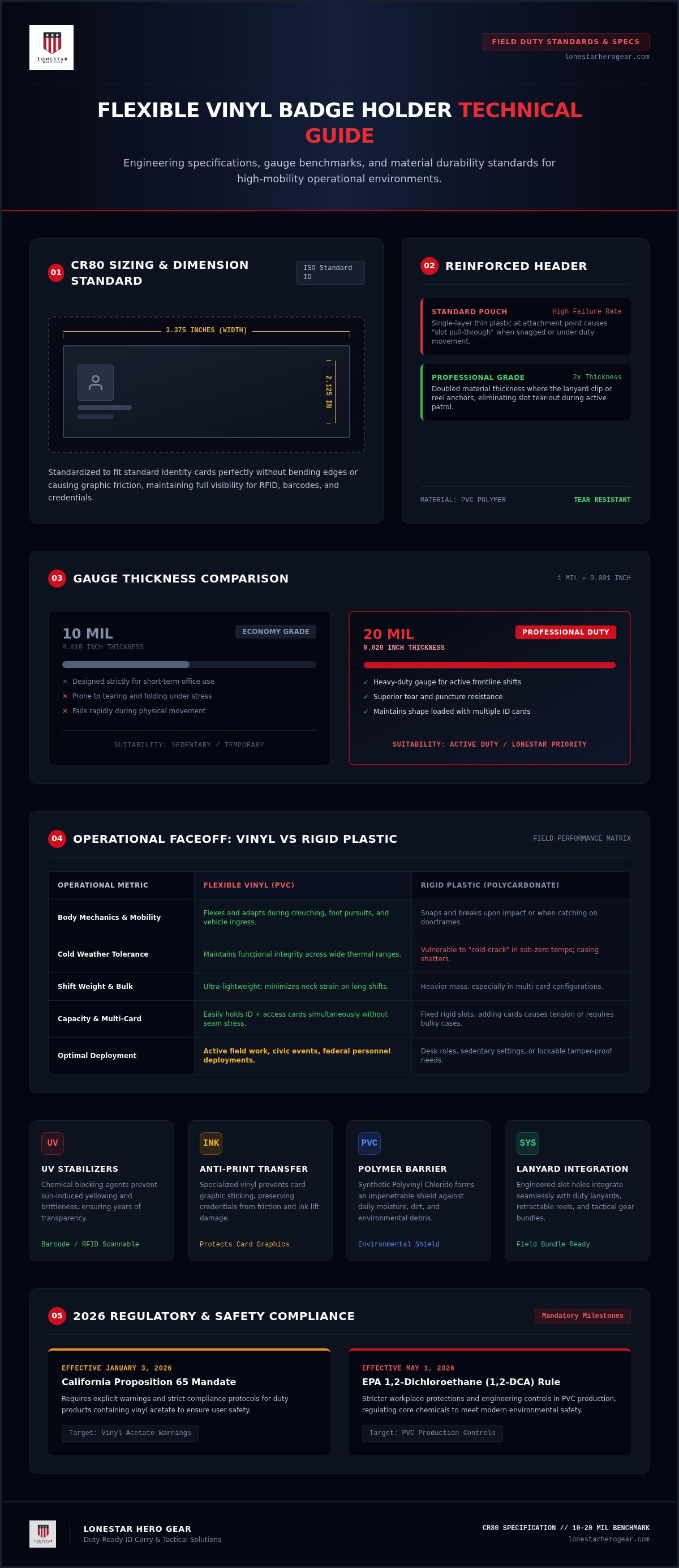
The header is the primary failure point. Standard pouches use a single layer of thin plastic at the attachment site. Professional gear features a reinforced header. This involves doubling the material thickness where the lanyard clip or badge reel connects. It prevents the "slot pull-through" common in high-movement roles. These holders protect credentials that adhere to international standards for identity cards, specifically the CR80 format measuring 3.375 inches by 2.125 inches.
Material Thickness: Economy vs. Professional Grade
Thickness is measured in mils. One mil equals one-thousandth of an inch. Economy sleeves typically sit at 0.010 inch, or 10 mil. These are suitable for short-term office use. They fail quickly under physical stress. Professional-grade carry requires 0.020 inch (20 mil) thickness. This heavy-duty gauge offers superior tear resistance. It maintains its shape even when loaded with multiple cards. It won't fold or crease during active shifts. Lonestar Hero Gear prioritizes these higher gauges for personnel who demand gear that survives the shift.
UV Resistance and Long-Term Clarity
Outdoor duty ruins standard vinyl. Sun exposure causes yellowing and brittleness. Professional badge holder vinyl includes UV stabilizers. These chemical agents block ultraviolet rays. They maintain transparency for years, not weeks. This clarity is vital for scannability. Barcodes and RFID chips must remain readable through the sleeve. If the plastic clouds, the gear is useless.
Safety regulations are evolving. Effective January 3, 2026, California Prop 65 requires clear warnings for products containing vinyl acetate. Duty-ready gear must prioritize safety and regulatory compliance. Furthermore, the EPA announced new regulations for 1,2-dichloroethane (1,2-DCA) on May 1, 2026. This chemical is central to PVC production. Manufacturers are now implementing stricter workplace protections and engineering controls. Choosing high-quality vinyl ensures you're using gear produced under these modern, rigorous safety standards. It protects the card, the user, and the mission.
Vinyl vs. Rigid Plastic: Choosing Your Duty Carry
Rigid plastic holders offer structural support. Vinyl offers operational freedom. For frontline personnel, rigidity is often a liability. A rigid holder snaps when you hit the deck or snag a doorframe. It doesn't yield. Flexible badge holder vinyl adapts to body mechanics. It bends during foot pursuits. It flexes during vehicle ingress. It doesn't shatter. It stays out of the way until you need it.
Weight matters on long shifts. A single rigid holder is negligible. A multi-card setup for access control, ID, and proximity cards adds bulk. Vinyl remains lightweight. It reduces neck strain when paired with duty-grade lanyards. The inherent properties of Poly(vinyl chloride) provide resilience without the mass of polycarbonate alternatives. This material stays functional across a wide thermal range, provided the gauge is sufficient for the task.
Environmental failure points differ by material. Rigid plastic suffers from cold-crack. In sub-zero temperatures, one impact shatters the casing. Your ID falls to the deck. Low-grade vinyl can heat-warp in extreme summer conditions, sticking to the card graphics. Professional badge holder vinyl maintains its shape better than cheap alternatives. For large-scale team deployments, the cost-to-performance ratio favors vinyl. It's the standard for civic events and federal personnel who need reliable, replaceable gear that doesn't compromise the mission.
When to Choose Flexible Vinyl
Active field work demands flexibility. If your shift involves bending, crouching, or physical intervention, choose vinyl. It won't dig into your chest or break under pressure. It's the ideal choice for multi-card storage. You can slide an ID and an access card into the same pouch without stressing the seams. It's efficient. It's light. For those seeking durable equipment, duty-ready ID holders provide the necessary reliability for active service.
When Rigid Plastic is Mandatory
Sedentary roles benefit from rigid carry. If you sit at a desk with minimal physical stress, a hard case works. High-security environments sometimes require "lockable" holders to prevent card tampering. Fragile smart chips or exposed magnetic strips also need the physical shield of a rigid shell. If your card costs fifty dollars to replace, the extra bulk is a justified trade-off. Rigid cases protect against card bending, which can ruin internal RFID antennae over time.
Sizing and Format Standards for Operational IDs
Precision fit is mission-critical. A loose credential is a lost credential. The baseline for most professional identification is the CR80 standard. Dimensions: 3.375 inches by 2.125 inches. This matches standard-issue credit cards and government licenses. Your badge holder vinyl must accommodate these dimensions with a "zero-slop" tolerance. Excessive internal space allows the card to shift. Movement creates friction. Friction destroys printed graphics and degrades the card's integrity over time.
Distinguish between internal and external dimensions. Internal dimensions dictate card fit. External dimensions dictate gear compatibility. A pouch that's too wide snags on equipment. It catches on seatbelts. It interferes with radio holsters. Aim for a slim profile that mirrors the card's footprint. For specialized missions, oversized credentials, like event passes or tactical placards, require dedicated large-format sleeves. Never force a card into a pouch that's too small. It stresses the seams and causes premature failure at the header. Lonestar Hero Gear provides sizing that respects these operational requirements for personnel who can't afford gear failure.
Vertical Orientation Protocols
Vertical carry is the standard for federal and military personnel. It aligns with chest-mounted clips and PALS webbing. This orientation minimizes lateral swing during movement. It keeps the ID centered on the torso. Standard vertical credentials prioritize portrait-style photos and tall barcodes. Ensure your lanyard attachment point is centered to maintain a neutral hang. This prevents the holder from flipping over during active duty. It's a requirement for high-security checkpoints where visibility is non-negotiable.
Horizontal Format Advantages
Horizontal layouts dominate municipal and corporate environments. This format provides the widest viewing angle for name, rank, and department details. It's the preferred choice for pocket-clip attachments. Horizontal badge holder vinyl sleeves distribute weight across a wider base. This prevents the "tipping" common with top-heavy vertical setups. It's the practical choice for rapid visual verification at checkpoints. If your role involves frequent face-to-face civic interaction, the horizontal format offers the most professional presentation. It integrates seamlessly with standard uniform pockets and shirt-front clips.
Match the format to the duty requirement. Orientation isn't a stylistic choice. It's an operational one. Select the layout that integrates with your existing loadout and meets your agency's visibility standards. Proper sizing ensures the gear survives the shift.
Maintenance and Environmental Protection Protocols
Operational readiness depends on gear maintenance. A clouded or fused ID pouch is a failure. Proper badge holder vinyl maintenance preserves optical clarity for barcode scanners and visual checkpoints. Neglecting these protocols leads to "Sticky ID" syndrome and premature material fatigue. Gear that survives the shift requires proactive care.
Preventing Card Damage and Ink Transfer
Ink transfer is the primary killer of professional credentials. Low-grade PVC contains plasticizers that migrate over time. This chemical process causes the card's graphics to bond permanently to the plastic sleeve. High temperatures, such as those found in patrol vehicles or against body armor, accelerate this bonding. Once fused, the card cannot be removed without destroying the surface printing. It's a costly mistake for agencies using high-security smart cards.
Use chemically inert, anti-print transfer vinyl to prevent bonding.
Avoid storing IDs in direct sunlight or high-heat environments for extended periods.
Replace sleeves immediately if you notice a "tacky" or sticky texture inside the pouch.
Professional-grade gear avoids these issues. Chemically stabilized vinyl maintains a barrier between the card and the sleeve. It keeps graphics sharp. It keeps cards removable for swiping or inspection. Don't let a cheap pouch ruin an expensive credential.
Environmental Seal Ratings
Field duty exposes equipment to moisture, dust, and grit. Choosing the right seal impacts both protection and access speed. Open-top designs provide the fastest card removal for swiping. However, they offer zero protection against rain or debris. Zip-lock resealable tops provide an environmental barrier. They keep moisture away from smart chips and magnetic strips. They're the standard for outdoor operations where weather is a factor.
Winter operations demand cold-crack resistance. Standard vinyl becomes brittle at freezing temperatures. One impact can shatter the pouch. Duty-ready 10 to 20 mil vinyl maintains flexibility in sub-zero conditions. This prevents the header from snapping during physical activity. It's the difference between a secure ID and a lost one.
Safety breakaway integration is mandatory for high-risk duty. If a subject grabs your lanyard or the holder snags on a moving vehicle, the attachment must fail safely. This prevents strangulation or blunt force trauma to the neck. Check your breakaway points weekly for signs of wear or plastic fatigue. A secure fit shouldn't come at the cost of personal safety. Cleaning procedures must be strictly followed. Use only mild soap and water. Never use glass cleaner or alcohol-based wipes. These chemicals react with the vinyl surface, creating a permanent haze. A clean badge holder vinyl sleeve ensures fast processing at every gate and checkpoint. For gear that stands up to these rigorous standards, shop duty-ready ID holders here.
Lonestar Hero Gear: Professional Vinyl Carry Solutions
Personnel in the field don't have time for gear failure. Lonestar Hero Gear supplies the frontline. Federal agents. First responders. Civic workers. We provide the occupational accouterments required for duty. Our badge holder vinyl solutions aren't consumer-grade trinkets. They're tactical-grade accessories. We understand the day-to-day requirements of service. Our gear survives the shift. Reliability is our baseline. We serve the people who serve the nation. Our focus remains on the tangible gear classifications you need. No conceptual rhetoric. Just duty-ready carry.
Procurement should be straightforward. No fluff. No lifestyle narratives. Just the purposeful acquisition of essential equipment. We support individual loadouts and large-scale team deployments. Whether you're at a municipal checkpoint or a federal installation, your ID carry must remain secure. We deliver quiet reliability for those who value substance over spectacle. It's a matter of institutional pride and dependable confidence.
The Lonestar Hero Gear Standard
We prioritize longevity. Our holders feature high-gauge vinyl, typically 10 to 20 mil. This thickness ensures maximum field durability. We focus on the high-stress areas. The header is reinforced. It resists slot pull-through during physical activity. The design is utilitarian. It's clean. It's professional. It meets the standard for duty carry without unnecessary bulk. We don't sell custom metal badge stamping. We sell protection for the credentials you already carry. Every pouch is built to maintain scannability and card integrity.
High-gauge material construction for maximum tear resistance.
Reinforced lanyard attachment points to prevent credential loss.
Anti-print transfer properties to protect card graphics.
Standard CR80 compatibility for a zero-slop fit.
Complete Your Loadout
Integration is key to a professional posture. Don't mix duty-ready holders with cheap cordage. Pair your badge holder vinyl with our Stars and Stripes bundle. These bundles provide a cohesive look for personnel who take pride in their service. Our accessories integrate seamlessly with existing duty bags, hats, and apparel. It's a complete system for the modern professional. These bundles match the discipline of the individuals who wear them. Whether you're carrying a basic access card or a high-security smart ID, our system maintains visibility and protection.
Check your gear regularly. Replace worn components before they fail. A secure ID is a requirement for operational security. We stand by the community of duty-bound workers. We provide the tools to keep you mission-ready. Lonestar Hero Gear is your dependable community outfitter. We're here for the long haul. Shop professional ID holders here to secure your credentials today.
Secure Your Credentials for the Next Shift
Operational security starts with reliable gear. Flexible carry outperforms rigid plastic for active personnel. It prevents snapping in sub-zero temperatures and yields during physical intervention. Technical specs are the difference between success and failure. Prioritize 10 to 20 mil gauge thickness and reinforced headers. These standards ensure your ID survives the rigors of the field.
A professional badge holder vinyl sleeve is essential EDC for any duty-bound worker. Lonestar Hero Gear offers field-tested gear trusted by first responders nationwide. Our patriotic-themed bundles provide a disciplined, unified look for federal and local personnel. Don't let a gear failure compromise your mission. Upgrade to Professional Duty Vinyl Holders today. Stay disciplined. Stay secure. Your gear should be as dependable as your service.
Frequently Asked Questions
What is the most durable thickness for a vinyl badge holder?
The most durable thickness for professional duty is 20 mil (0.020 inch). Standard office sleeves use 10 mil gauge, which lacks the structural integrity for field work. Heavy-duty vinyl provides superior tear resistance at the attachment point and maintains its shape under physical stress. First responders and military personnel should prioritize these higher gauges to ensure gear survives the shift without cracking or failing during active movement.
Will my ID card stick to the vinyl in hot weather?
Low-grade vinyl contains plasticizers that cause ID cards to stick and transfer ink in high heat. This bonding ruins the card's graphics. Use chemically inert, anti-print transfer vinyl to prevent this chemical migration. This is critical for personnel storing gear in patrol vehicles or wearing it against body armor. Professional-grade badge holder vinyl prevents the "Sticky ID" problem and keeps credentials removable for inspection or swiping.
Are vinyl badge holders waterproof or just water-resistant?
Most holders are water-resistant, but specific zip-lock designs offer weatherproofing. Standard open-top pouches provide zero protection against rain or moisture ingress. Resealable zip-top models create an environmental barrier that protects smart chips and magnetic strips from grit and humidity. While not rated for submersion, these sealed designs are the standard for outdoor operations. They keep credentials dry and scannable during inclement weather shifts across all environmental conditions.
Can I use an RFID card through a vinyl holder?
RFID and proximity cards function normally through standard vinyl sleeves. The material does not contain metal shielding that blocks radio frequency signals. You can scan your credentials at access points without removing them from the holder. This maintains operational speed at checkpoints. If you require signal blocking for security, you must use a dedicated shielded holder. For standard duty cards, a high-gauge badge holder vinyl sleeve provides protection without interfering with electronic readers.
How do I prevent the top of my vinyl holder from tearing?
Prevent tearing by selecting holders with reinforced headers. This design doubles the material thickness at the slot where the lanyard clip or badge reel attaches. It's the primary failure point for economy gear. Avoid using heavy badge reels on single-layer headers. Ensure your attachment clip is smooth and free of burrs. Regularly inspect the slot for signs of plastic fatigue. Switching to a 20 mil gauge holder significantly reduces the risk of pull-through during high-movement activity.
What is the difference between PVC and vinyl badge holders?
PVC and vinyl are functionally the same material in this context. PVC stands for Polyvinyl Chloride, which is the polymer used to create flexible vinyl sleeves. The real difference lies in the additives and manufacturing quality. Professional-grade vinyl includes UV stabilizers and anti-print transfer chemicals. Economy PVC often lacks these stabilizers, leading to yellowing and card damage. Focus on the mil-thickness and chemical properties rather than the nomenclature to ensure you're getting duty-ready equipment.
Which is better for outdoor work: vertical or horizontal holders?
Vertical holders are generally superior for active outdoor work. This orientation aligns better with the torso and reduces the risk of snagging on equipment or seatbelts. It centers the weight on lanyards and chest clips, minimizing lateral swing during foot pursuits. Horizontal holders are better suited for stationary checkpoints where name and rank recognition are the priority. Choose the vertical format if your shift involves frequent crouching, bending, or physical intervention to maintain a tactical profile.
How do I clean a cloudy vinyl badge holder?
Clean cloudy vinyl using only mild soap and lukewarm water. Apply the solution with a soft, non-abrasive cloth to remove surface dirt and oils. Never use glass cleaners, alcohol-based wipes, or harsh detergents. These chemicals react with the PVC surface and create a permanent haze or brittleness. If the clouding is internal due to plasticizer migration or heat damage, the material has reached its end of life. Replace the holder to maintain credential legibility.


Comments