
Rigid Plastic Badge Holder: The Ultimate Duty-Ready Buying Guide

EQUIPMENT FAILURE IS NOT AN OPTION ON THE JOB. Your ID card represents your authority and access. If you're using a flimsy sleeve, you're one snag away from a security incident. Most professionals view a rigid plastic badge holder as a minor accessory until it cracks in the field or drops a PIV card during a critical transition. You need gear that matches your operational tempo. Fragile plastic and weak clips don't belong on a duty belt or uniform. We understand that credentials are gear, not office supplies. It's time to treat them with the same respect as the rest of your kit.
This guide shows you how to select a carrier that survives high-impact environments and secures your essential IDs. You'll learn to identify impact-resistant materials that won't yellow or snap under pressure. We'll examine secure locking mechanisms and RFID shielding requirements that protect your data from unauthorized scans. From CR80 dimensions to heavy-duty attachment points, this is your checklist for professional-grade protection. Secure your credentials. Maintain your professional appearance. Ensure your gear lasts as long as your shift.
Table of Contents
Why Standard Badge Holders Fail in High-Activity Duty Environments
Standard office supplies don't belong in the field. They're designed for climate-controlled cubicles and low-impact movement. Duty environments involve physical exertion, gear snags, and environmental extremes. A standard holder isn't just inadequate; it's a liability. When your equipment fails, you lose access. You lose time. You compromise security.
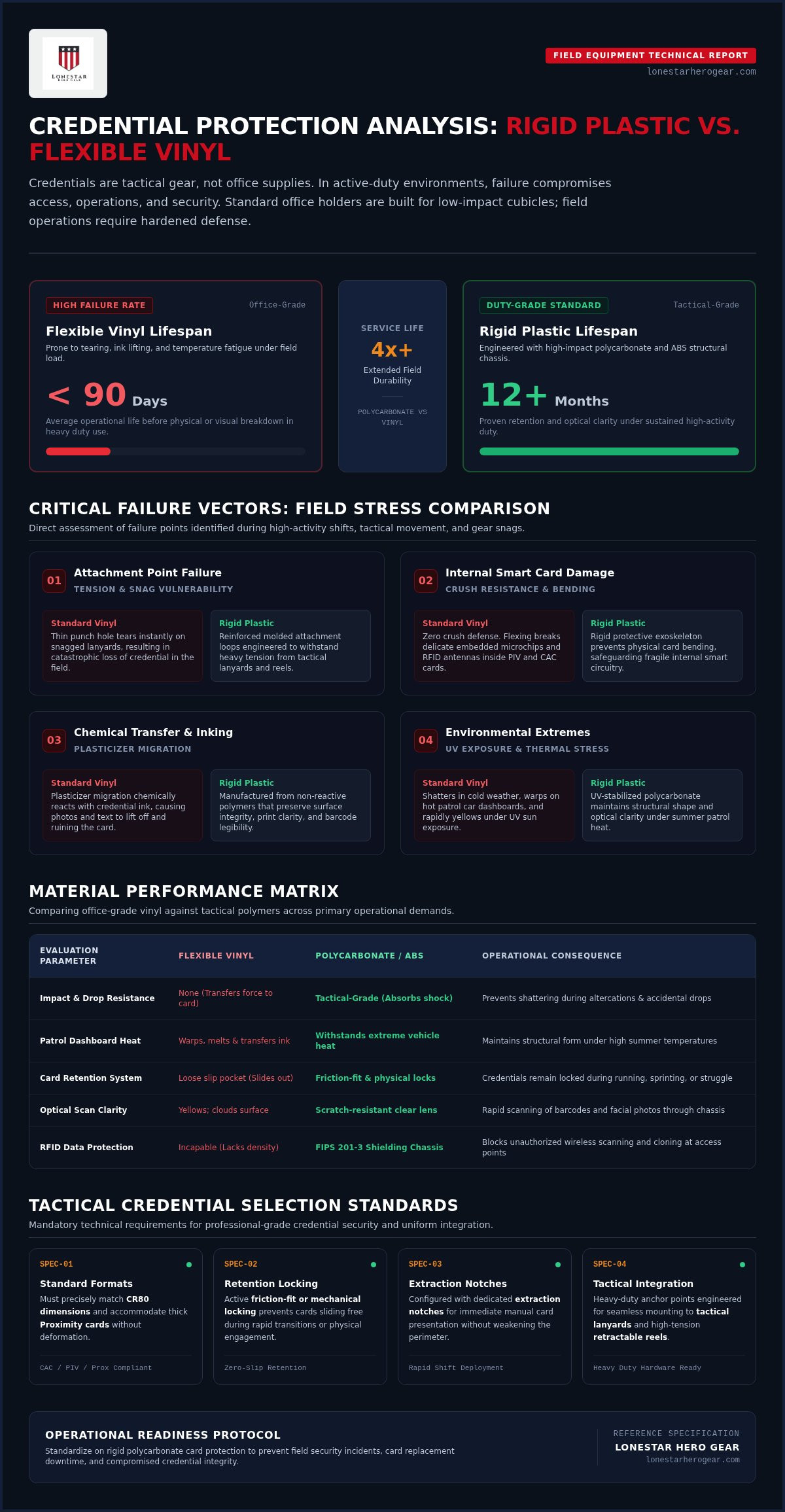
Field-use demands exceed the capabilities of retail-grade plastic. Common failure points include brittle materials that shatter in cold weather and thin attachment loops that snap under tension. UV exposure is another silent killer. Constant sun yellowing obscures the card face and weakens the structural integrity of the plastic. Losing a critical identity document in a secure facility leads to immediate operational friction. The cost of replacement, security paperwork, and downtime far exceeds the price of proper gear. You need a rigid plastic badge holder that stays attached and intact.
The Vulnerability of Flexible Vinyl
Flexible sleeves are the weakest link in any kit. The punch hole is the primary failure point. One hard tug on a snagged lanyard and the card is gone. Chemical transfer is another persistent issue. Over time, flexible vinyl reacts with the card's ink, causing the image to "lift" off the credential. This ruins expensive PIV and CAC cards. Flexible vinyl offers zero protection against crushing. A bent smart card is a dead smart card. The internal antennas and chips are fragile. They require a solid frame to survive daily physical stress.
Rigid Plastic as a Duty Requirement
Active-duty movement requires crush resistance. Whether you're entering a vehicle or maneuvering through tight spaces, your gear takes hits. A rigid plastic badge holder provides a protective exoskeleton. It prevents the bending and snapping of internal card components. Secure card retention is mandatory. Duty-grade holders use friction fits or physical locking mechanisms. The card won't slide out during a sprint or a struggle. Professional appearance also matters. A cracked, yellowed sleeve looks sloppy on a uniform. A clean, structured holder maintains professional standards. It projects discipline and readiness. Substance over spectacle starts with the gear you wear every day.
Crush-resistant polycarbonate construction.
Secure friction-lock retention.
UV-stabilized materials to prevent yellowing.
Heavy-duty attachment points for tactical lanyards.
Rigid Plastic vs. Flexible Vinyl: The Case for Hardened Protection
Material choice determines equipment lifespan. Flexible vinyl is a temporary solution. It typically fails within 90 days of heavy field use. A rigid plastic badge holder built from polycarbonate or ABS plastic serves for 12 months or longer. These materials prevent card deformation. They eliminate print transfer. Standard vinyl often leeches ink from the card face due to plasticizer migration. It's a common issue that ruins expensive credentials. Rigid builds use non-reactive polymers. Your cards remain legible and scannable. Equipment reliability starts with the base material.
Polycarbonate: Tactical Grade ID Armor
Polycarbonate is the industry standard for impact resistance. It handles physical altercations and accidental drops without shattering. It withstands extreme heat. Dashboards in patrol vehicles reach high temperatures during summer months. Polycarbonate maintains its structural shape while cheaper plastics warp or melt. It offers superior optical clarity. Scratch resistance ensures barcodes and photos remain scannable through the lens. Choosing duty-ready ID holders made from these materials reduces long-term gear replacement costs. If you're operating in high-impact environments, polycarbonate is the only logical choice.
RFID Shielding and Security Features
Security involves more than physical retention. Modern credentials contain sensitive chips and antennas. These must follow the FIPS 201-3 standard for federal and military access. Rigid holders act as a structural chassis for RFID shielding layers. They block unauthorized scanning attempts. They prevent cloning at gate access points. A flexible sleeve cannot support effective shielding. It lacks the necessary material density to block signals effectively. Rigid protection is a requirement for high-security environments. It protects the electronic integrity of the card alongside the physical surface.
Material Performance Comparison:
Vinyl: 3-month average lifespan. High risk of card damage and ink lifting.
ABS Plastic: Moderate impact resistance. Lightweight. Professional matte finish.
Polycarbonate: Maximum durability. 12+ month lifespan. Heat stable and crystal clear.
Shielded Rigid: Electronic protection. Blocks 13.56 MHz frequencies. Mandatory for secure facilities.
Essential Features for Tactical and Professional Credential Security
Operational gear requires specific functional attributes. A standard sleeve holds a card. A duty-ready rigid plastic badge holder secures a credential. Selection depends on specific access requirements and movement levels. Loading direction is a primary security consideration. Top-load designs are common but carry a risk of card ejection if inverted during physical activity. Side-load variants offer superior retention. They utilize the attachment clip as a secondary physical barrier. If the clip is engaged, the card cannot slide out. It's a simple, mechanical fail-safe for active personnel.
Rapid access is non-negotiable. Thumb notches facilitate quick manual extraction for magnetic stripe readers or visual hand-offs. Without a notch, card removal becomes a clumsy, two-handed operation. Attachment point reinforcement is equally critical. The loop where the lanyard or reel connects is the most common failure point. Duty-grade holders feature thickened plastic or metal-reinforced eyelets. This prevents loop snap during gear snags or foot pursuits. Durable gear ensures the ID stays on the person, not on the ground.
Locking vs. Open-Faced Designs
Security protocols dictate holder style. Permanent locking holders are standard for high-security environments. Once inserted, the card is trapped. Removal requires breaking the holder or using a specialized key. This prevents credential tampering and loss. Open-faced rigid designs prioritize visibility. They allow for rapid visual inspection by security checkpoints while protecting the card edges. Friction-fit technology provides a middle ground. Internal springs or tension bars hold a single card firmly in place without a full front cover. This maintains access speed without sacrificing security.
Multi-Card Duty Carriers
Modern duty often requires multiple credentials. Professionals carry PIV or CAC cards alongside department IDs or transit passes. Multi-card carriers manage this bulk. Separation layers are essential. They prevent card-on-card friction that degrades magnetic stripes and printed surfaces. Effective designs maintain a slim profile. Excessive bulk interferes with uniform fit and snag-free movement. A dual-sided rigid plastic badge holder organizes gear efficiently. It keeps essential access tools in one predictable location.
TOP-LOAD: Standard access. Best for stationary or office-based duty.
SIDE-LOAD: Enhanced retention. Recommended for field operations.
THUMB NOTCH: Rapid extraction. Mandatory for swipe-access cards.
REINFORCED EYELETS: High-tension durability. Prevents lanyard detachment.
LOCKING MECHANISM: Maximum security. Required for non-removable credential policies.
Integrating Rigid Holders with Duty Uniforms and Tactical Lanyards
Gear integration is a functional requirement. Your rigid plastic badge holder must interface seamlessly with your loadout. Tactical vests and OCP uniforms present specific mounting challenges. You cannot afford gear that flaps or snags during rapid movement. Zero-snag protocols are mandatory for front-line personnel. This means selecting attachment points that keep the credential tight to the torso. Avoid mounting on external pouches where gear might catch. Use dedicated lanyard loops or uniform-integrated attachment points. Proper placement ensures the ID is visible but out of the way of primary equipment.
The Lanyard and Rigid Holder System
Weight distribution is critical for long shifts. A heavy-duty breakaway lanyard is the safety standard. It prevents strangulation risks in industrial or tactical settings. The lanyard must support the weight of a rigid plastic badge holder without sagging. Ensure the holder sits flat against the chest. A twisting carrier is an operational distraction. Flat orientation ensures the photo remains visible for rapid identification. High-quality webbing prevents neck irritation during 12-hour shifts. Shop heavy-duty lanyards designed for tactical weight requirements.
Retractable Reel Tension and Weight
Rigid carriers weigh more than flexible alternatives. Multi-card rigid builds require specific spring tension. You must calculate this tension to prevent badge droop on duty belts. If the spring is too weak, the holder hangs below the belt line. This causes interference with other gear like holsters or radio pouches. Choose steel cords for high-frequency use. Nylon cords often fray under the weight of heavy polycarbonate frames. A steel cord provides the durability needed for thousands of extension cycles. Match the reel's pull strength to the total weight of your loaded carrier. This prevents the holder from bouncing during a sprint.
Duty Integration Checklist:
Tension: 6oz to 10oz pull strength for dual-card rigid carriers.
Safety: Breakaway connectors at the neck and sides for hazard environments.
Uniform: Chest-center mounting for OCP and tactical vest compatibility.
Material: Braided steel wire for maximum tactical longevity.
Orientation: Vertical or horizontal alignment that matches your specific ID format.
Selecting Your Duty-Grade Rigid Plastic Badge Holder
Gear selection is mission critical. You aren't buying office supplies; you're selecting essential kit. Start with the credential type. Most government and military IDs follow the CR80 format, measuring 86mm x 54mm. Verify your card thickness before acquisition. Standard PIV or CAC cards fit most frames. Proximity cards or dual-chip credentials require deeper housings. Force-fitting a thick card into a standard frame causes structural stress. It leads to premature failure. Check your card specs. Ensure a proper fit.
Movement levels dictate your retention needs. Static security posts allow for open-faced designs. Field operations require total containment. Assess your environment for impact risks and snag hazards. If your duty involves physical altercations or rapid movement through tight spaces, a side-loading polycarbonate carrier is the baseline requirement. RFID shielding is an operational requirement in secure facilities. It prevents unauthorized scanning of 13.56 MHz credentials. If you work in a high-security zone, a shielded rigid plastic badge holder isn't optional. It's a security mandate. Secure your identity. Maintain your access.
The Lonestar Hero Gear Standard
We provide gear for those who serve. Our selection is curated specifically for first responders, federal agents, and military personnel. We prioritize heavy-duty construction. We reject disposable retail standards. Every item in our inventory meets an operational checklist for durability and professional appearance. You need equipment that stays intact when the situation escalates. View our selection of ID Holders and Lanyards to find field-ready hardware for immediate deployment. We function as your community quartermaster. We value substance over spectacle.
Final Checklist for Gear Acquisition
Run your final equipment check before acquisition. Material integrity is the first priority. Polycarbonate is the preferred material for impact resistance and thermal stability. Security is the second priority. Determine if your protocol requires a permanent locking holder or a friction-fit design for frequent card removal. Integration is the final step. Ensure your rigid plastic badge holder eyelet matches your lanyard clip or retractable reel. Mismatched hardware creates weak points. It leads to gear loss. Don't compromise your loadout with inferior components.
Operational Selection Checklist:
CREDENTIAL: Verify CR80 standard dimensions or Proximity card thickness.
SECURITY: Identify RFID shielding needs for secure facility access.
MATERIAL: Confirm polycarbonate construction for high-impact duty environments.
HARDWARE: Match holder eyelets to existing lanyard or reel attachments.
RETENTION: Choose side-load or locking formats for maximum field security.
SECURE YOUR CREDENTIALS FOR THE FIELD
Standard office supplies aren't built for the rigors of service. You've learned that polycarbonate construction and secure locking mechanisms are non-negotiable for high-impact environments. A rigid plastic badge holder protects your identity documents from crushing, UV damage, and unauthorized scanning. Proper integration with heavy-duty lanyards and badge reels ensures your kit remains intact during critical operations. We specialize in gear for military and first responders who value substance over spectacle. Don't let a flimsy sleeve compromise your security or professional appearance. Invest in hardware that stands up to your operational checklist. Our tactical accessories provide professional-grade durability for those on the front lines. Secure your access points with confidence. Maintain your gear with discipline.
Upgrade Your Duty Gear with Lonestar Hero Gear ID Holders. Trust the equipment that's built for heavy use. Stay ready for the next shift.
Frequently Asked Questions
What is the best material for a rigid plastic badge holder?
Polycarbonate is the superior material for duty use. It offers maximum impact strength and maintains structural integrity under thermal stress. Standard ABS plastic provides a lightweight alternative but lacks the extreme durability of polycarbonate. Avoid generic retail plastics that shatter upon impact. Professionals require gear that survives physical altercations and gear snags. Polycarbonate remains clear and scratch-resistant over long-term deployment. It is the gold standard for tactical environments.
Can a rigid badge holder protect my ID from RFID skimming?
Shielded rigid holders block unauthorized RFID skimming. These carriers incorporate metallic layers to intercept 13.56 MHz frequencies used by PIV and CAC credentials. This protection is critical for federal and military personnel operating in secure zones. While the FIPS 201-3 standard no longer includes accessory testing, high-quality shielded holders are designed to meet these security requirements. Ensure your rigid plastic badge holder features built-in shielding to prevent electronic data theft.
How do I remove a card from a rigid holder with a thumb notch?
Card removal is a one-handed operation. Place your thumb in the center notch and apply upward or outward pressure. The friction-fit mechanism releases the card as you slide it through the loading slot. This design facilitates rapid magnetic stripe swiping or visual inspections at security checkpoints. It eliminates the need to remove lanyards or clips during access transitions. Thumb notches are an essential feature for duty-grade equipment.
Will a rigid badge holder crack in cold weather?
Polycarbonate frames don't crack in extreme cold. They're engineered for thermal stability and impact resistance across broad temperature ranges. Standard office-grade plastics become brittle and shatter when exposed to freezing conditions. If your duty environment involves winter field operations, duty-grade materials are mandatory. Polycarbonate maintains its flexibility and strength where cheaper alternatives fail. Reliability in all weather conditions is a requirement for professional gear.
Are rigid holders compatible with all types of lanyards?
Most rigid holders utilize standard 1/8-inch eyelets. These are compatible with bull-dog clips, swivel hooks, and split rings. However, duty-grade carriers require heavy-duty lanyards for proper weight distribution. A thick polycarbonate frame can cause badge droop on flimsy retail lanyards. We recommend pairing your holder with a tactical-grade lanyard featuring a breakaway safety connector. Ensure the attachment point is reinforced to prevent loop snap during physical exertion.
Can I carry two cards in one rigid plastic badge holder?
Dual-sided carriers are designed for multiple credentials. You can secure a PIV card on one side and a department ID on the other. Some deep-well models accommodate up to three standard CR80 cards. These carriers often feature internal separation layers. This prevents card-on-card friction and magnetic stripe degradation. A multi-card rigid plastic badge holder maintains a slim profile while organizing essential access tools. It's a standard requirement for modern multi-agency operations.
How long does a polycarbonate badge holder typically last?
Polycarbonate holders typically last 12 months or longer under heavy field use. This significantly outperforms flexible vinyl sleeves, which often fail within 90 days. Durability depends on the frequency of card extraction and environmental exposure. UV-stabilized materials prevent the yellowing and brittleness common in cheaper plastics. Investing in professional-grade hardware reduces long-term replacement costs. It ensures your credentials remain secure throughout your entire deployment cycle.
Is a top-load or side-load rigid holder more secure?
Side-load holders offer superior security for active personnel. The attachment clip acts as a physical barrier that prevents the card from sliding out. Top-load designs are suitable for office environments but risk card ejection during high-activity movement or foot pursuits. If your duty involves physical exertion, side-load is the tactical choice. It provides a mechanical fail-safe that keeps your ID secured to your person at all times.


Comments